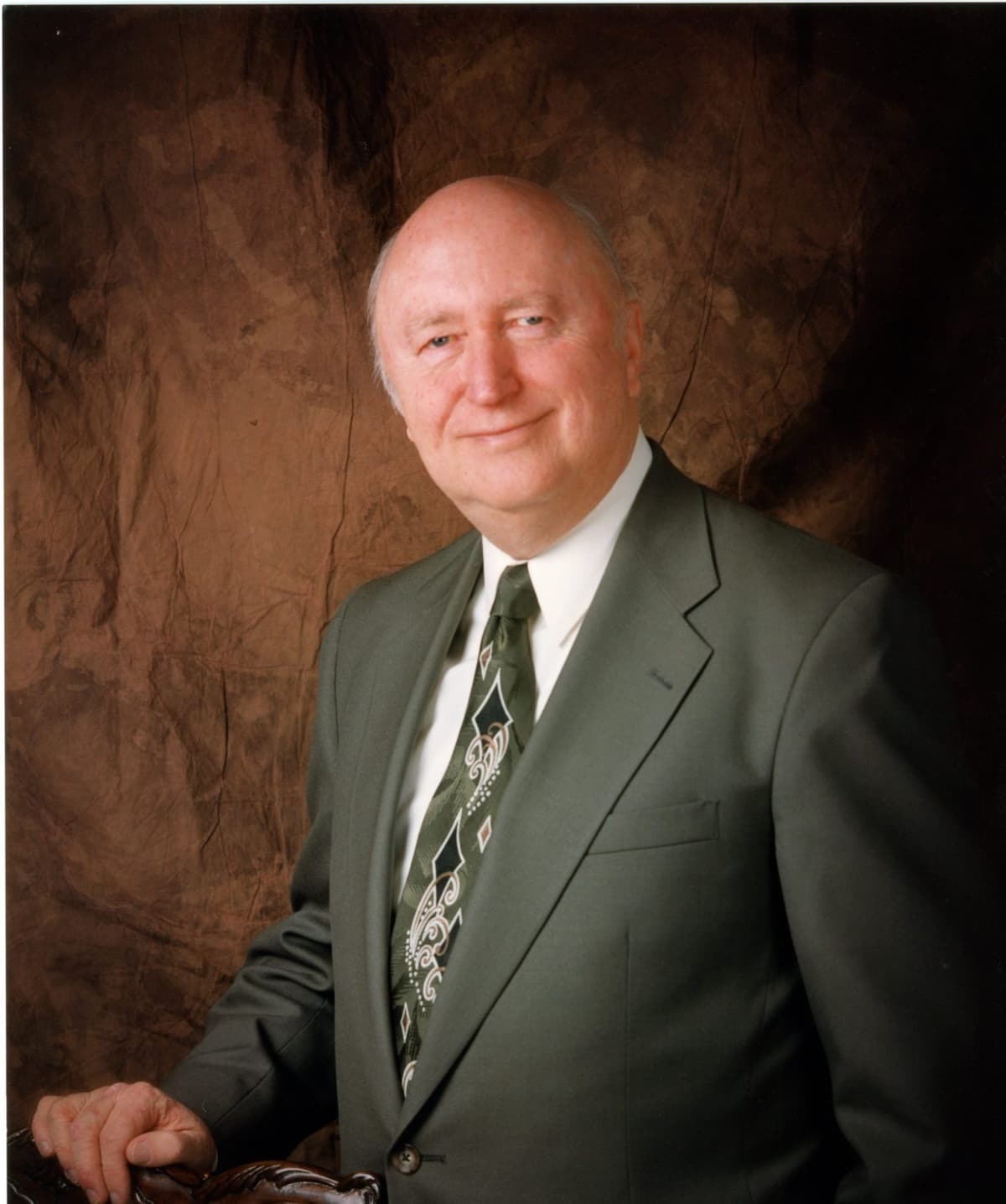


In advance of his visit to campus February 23-24, 2026, renowned Bible scholar and former Bishop of Durham N.T. Wright was interviewed by Seattle Pacific Seminary Dean Brian Lugioyo about his new book, God’s Homecoming: The Forgotten Promise of Future Renewal. Other topics included reimagining memorial services, the importance of teaching Scripture to college students, encouragement for church leaders, and what continues to astonish him about Jesus. To watch the interview, visit SPU’s YouTube channel.
Brian Lugioyo: Thanks for doing this. …
N.T. Wright: Well, thank you and I’m looking forward to being with you in a few weeks time. It seems a little odd really to say that. I’m on the West Coast of Scotland at the moment and thinking of being on the West Coast of America is kind of, oh my goodness, how does that work? But there we are. It will happen.
Brian Lugioyo: Yeah, we’re really excited and looking forward to it. I think this’ll be your third visit to SPU.* Is that right?
N.T. Wright: Quite possibly, though it’s been a long time actually, or at least my first time was many years ago.
Brian Lugioyo: Well, I’ve just got a few questions for you and then we can just banter a little bit. So you’ve written about the “going to heaven to be with God” narrative before in Surprised by Hope, and so what prompted you to revisit this in God’s Homecoming?
N.T. Wright: It’s a good question. I think that two or three things which have converged. I mean Surprised by Hope was written 20 years ago and published in I think 2007, 2008, on the two sides of the Atlantic. But Surprised by Hope was really a whole venture into the unknown for so many of my readers, and indeed when I was working it through over the previous decade for myself, realizing actually this is how the Bible narrative works. But since then, two things have happened. One is I’ve spent a lot more time in the Old Testament predictions of God’s coming, God’s return, God’s coming back to Zion, all of this. And that has made me realize that so much of the tradition that I grew up in was thinking that well, the Old Testament was about this worldly stuff. It was about land and family and ethnicity.
And then Jesus comes along and says, “No, we don’t do all that stuff. The point is now the kingdom of heaven. We’re going off to heaven.” Now, so even if we then say well, the going to heaven narrative doesn’t quite work, people haven’t really joined the dots and seen that the real break if you’d like, comes not between Old and New Testaments, but between the whole biblical revelation and the fourth and fifth century and onwards neoplatonism, which then elevates this idea of a soul going to heaven into the primary narrative. So what I’m trying to do in this book in a way that I’ve not done before is to spend quite a bit of time in the Old Testament promises, both about Yahweh’s return to Zion and about the coming time when the earth shall be full of the glory or the knowledge of God as the waters cover the sea.
And to show then how those two narratives, God’s return to Zion and then God coming to flood the whole creation with his own salvific and glorifying presence, these are then drawn together in the New Testament in a quite dramatic way. And it was only when I was working through this really over the last five years that I came to realize that actually the first of those narratives, the return of Yahweh to Zion comes through with a bang into New Testament Christology. This is the story of Jesus, is the return of Yahweh to Zion. The story about Yahweh himself flooding the whole creation with his own presence is what is then partially fulfilled and anticipated in the gift of the Holy Spirit.
So that the scene on the day of Pentecost about the Spirit filling the house and filling the disciples, the language which is used there and in other similar passages like Galatians 3 and so on, is very reminiscent of those passages about God filling the whole creation. So that I’ve come to see, and I had a little book on Ephesians published last year, which says that the church is designed to be the place where God’s intention for the whole creation is being anticipated in the present, in the filling of the church with the Spirit.
So those two themes have kind of grown up. It’s a funny thing to observe in the mirror to look at one’s own thought developing. I hadn’t seen any of this 10 or 15 years ago, but now I think if I was to sit down from scratch and write a book about New Testament Christology and pneumatology, this is probably how I’d do it, and in a sense, that’s what this book is about. So all of that has been going on and has been very exciting. I’ve just enjoyed it enormously and it’s been very illuminating for me. But in particular, what struck me over the last decade or 15 years, is that the temple theme in the whole of scripture of God seeing creation as a temple — a heaven plus earth reality with an image at its heart. And then the way in which this plays out through the temple scenes in, well, the tabernacle in Exodus 40, the temple in 1 Kings 8, etc. Then again, the way that that whole strand of thought is retrieved and celebrated in the New Testament because so many Christians imagine that the temple, well, that was a great Jewish building like a big old cathedral or something, but we don’t do that sort of thing now. And actually the New Testament says, yes, you really do because you are the new temple. You are the temple of the living God and that ultimately the whole creation is going to be God’s tabernacle, and that line of thought then goes all the way on of course, to Revelation 21. So all of these things the themes have been bubbling along in my lecturing in my delving into passages here and there. So this book was an attempt to bring it together. But as I did that, I realized that every time I lectured about this, people were saying, “So how do we get it all so wrong?” Which is a good question.
The middle section of this book, and it’s not really my area of expertise, is a quick trip through from the second century through to the post-reformation era when people are asking the neoplatonic question, “How does my soul get into heaven?” And so I’m talking about the ways in which the reformers were determinedly biblical, but they were trying to give biblical answers to those medieval questions, etc. And that’s a really complicated story, but then having gone through that, I then have some concluding chapters. Have you had a chance to look at the book or seen the text yet or maybe not?
Brian Lugioyo: No.
N.T. Wright: Okay, so I have some concluding chapters on various things like the unity of the church, like the sacramental life of the church and various other things which look quite different if you see them within this larger narrative — I mean obviously with the sacramental life of the church. I mean it’s kind of funny because I’m a cradle Anglican, the sacramental life has been central to me, but often in a very low church way. And though I wouldn’t describe myself as a high churchman exactly, I now see the point much more of a vivid sense of the presence of Christ in the Eucharist within that biblical framework rather than the Aristotelian framework which obtained in the Middle Ages and which produced kind of classic Roman Catholic transubstantiation theory, etc. So what I’m trying to do is to emphasize that if we come at the whole larger question of church life from this point of view, lots of things now look very different, and that’s been a very exciting journey. So long answer to a very good question.
Brian Lugioyo: Well, I mean it’s a question that requires a long answer in some ways. One thing to just follow up on, and it looks like the book might be touching on this, is how have you seen maybe funerals, reshaped by this vision? Because I feel that the “so-and-so’s not here, they’re now in heaven,” is the dominant narrative.
N.T. Wright: Absolutely.
Brian Lugioyo: So how would a liturgy or a funeral service be reimagined?
N.T. Wright: Absolutely, that’s a great question and there is a whole chapter towards the end of the book where I deal with this question. And actually, my wife and I were with some friends just two weeks ago who’s the paterfamilias, the father of the family, had just passed away on Christmas Eve and we were talking with his widow and his son and daughter-in-law, etc., precisely about these issues. So it’s quite fresh in my recent mind as well as theologically. That’s where I then develop the notion of the indwelling spirit in the present as the means of continuity with the situation as Paul describes in Philippians 1 where he says, “My desire is to depart and be with the Messiah, which is far better.” We can talk about and celebrate the fact of the late departed brother or sister being with the Messiah, but instead of invoking the medieval Aristotelian notion of the soul as the carrier of that, I would say now that as in Romans 8, Paul says, “The Spirit bears witnessed with our spirit.” And in 1 Corinthians he says, “We are one spirit with him.”
So it seems to me that upon death, the Christian can be assured that the Spirit who has indwelt them in the present is continuing to look after them in the nearer presence of Jesus until the time when they are given their resurrection bodies, and that needs to be worked through and thought through and prayed through in terms of how we do funerals. I’ve actually been quite depressed in many recent funerals that I’ve been to, even in devout evangelical godly biblical churches where the whole narrative is simply well, they’re now upstairs with Jesus, so that’s all right, isn’t it? And that seems to me both trivilizing in itself and a severe diminution of the promise of resurrection. The old Anglican burial service that was in the old prayer book that I grew up with actually has the whole of 1 Corinthians 15 baked into it. You read that whole chapter so that until the modern period, most Anglicans probably knew a lot of 1 Corinthians 15 by heart because you go to funerals in your village quite a lot. And that would mean that the idea of a present rest and then a future reembodiment with a new body, a new kinder body, a body animated by God’s spirit. Again, it’s really important that that would’ve been more common knowledge and we’ve kind of lost that.
So I do think there’s room for a great deal of fresh thought and practice and fresh liturgies to be drawn up. Emphasizing the glory of the ultimate future hope, which as I say, is often lost. To think of going to good Christian funerals where there’s no mention of resurrection, that seems to me bizarre, and yet I have been to those funerals. But then how to talk about the “where are they now” question, which is what we today want to address. But interestingly, the early Christians don’t seem to have wanted to address that particularly. That’s our question, not theirs. In so far as they do, their answer is to do with the Spirit and with being with Christ. They kind of leave it at that and so you’re at rest waiting for the resurrection. So yes, there is a lot of fresh thinking and working to be done on that whole question.
Brian Lugioyo: That’s exciting. Looking forward to the book. Let’s just transition a little bit. You’ve been deeply involved on college campuses most of your career, and including some visits to SPU, and visits to lots of Christian colleges and seminaries across the U.S. and U.K., Europe, and abroad. How would you articulate today after having a very full career, the importance of teaching the Scriptures with or for students?
N.T. Wright: I mean at least in America, you do still have a lot of students who come to college having been at very much Bible churches, so that even if what they’ve been taught from the Bible may not be as thorough as I would like, they often do at least know their Bibles reasonably well and are ready to go to the next stage, perhaps you could say. So I think anything that forms people as Bible readers, as grown-up Bible readers, in other words, we’re not just going back to the Sunday school lessons. We’re trying to say, what are Matthew, Mark, Luke, and John all about? What is Isaiah all about? What is Genesis all about in a mature way, not in a kind of proof texting way? Then I think that’s what we should be doing again and again.
Now, the campuses where I’ve worked myself in Oxford or Cambridge or then laterally in St. Andrews, many of the students, even Christian students, have very little biblical knowledge. It’s kind of depressing. Even people who come up to the university to study theology have only a smattering of bits and pieces, because I think the churches are not really teaching, certainly in the U.K., not really teaching a whole Bible, a full Bible understanding and knowledge. It’s more that we have this basic narrative that we’ve said a prayer, so we’re going to heaven, so that’s all right, and by the way, the Bible proves it. Now, that’s trivializing, but you hear what I’m saying now, rather than saying, “This book is alive.” It’s got all sorts of stuff going on, which revolutionizes us, which transforms us, which gives us hope in dark times, etc. And boy, do we need that right now for all sorts of reasons. Let’s wrestle with it. Let’s wrestle with the question of what does the Bible say about human authorities, about governments and civilizations and so on.
And people are asking those questions and often they’re not expecting to find answers in the Bible. I happen to be in my own private reading working through the Book of Daniel again. Oh my goodness, empires, the rise and fall of empires and God being somehow sovereign over it all, even though it’s very scary and gives us a headache and so on. All of that stuff needs to be drawn out. So I want to say that the opportunity is there. We need teachers to grasp that opportunity and work through this sort of thing with often very bright students. However bright they are, if they’re not led into wise ways of reading scripture, they may just not get it.
Brian Lugioyo: Yeah, I mean you served as a bishop as well and you’ve been a theologian of the church for a long time, and you just finished also a book on Ephesians, The Vision of Ephesians, the Task of the Church. What might be a word of advice or encouragement out of Ephesians out of that work that you’ve done that you’ll be sharing also with pastors and leaders in Seattle in a couple of weeks?
N.T. Wright: Sure. Well, some years ago, I guess maybe 15 years ago, I was at a conference in Wheaton College, Illinois, and I had to preach a sermon to the entire student body, and I took my courage in both hands and I was given about 20, 25 minutes, and I did the whole of the letter to the Ephesians. I challenged them. I said, “If you’re acting in a play as many of you might be, you would know much more text than is here in Ephesians by the end of term, by the time the play was put on.”
Brian Lugioyo: I was there. I remember you challenging us to memorize the whole book.
N.T. Wright: Memorize it.
Brian Lugioyo: Yes.
N.T. Wright: Oh, wonderful. Oh, great. So you remember that? I remember it vividly and you may be amused to know two or three years later, I don’t know whether it was an email or a card or something, I heard from a couple who were Wheaton grads who said, “We both took that seriously and we set off learning Ephesians and then we got engaged and now we’re married.” And I thought, “Oh my goodness, Ephesians is a marriage bureau. Well, why not? It’s got one of the most amazing marriage passages in the whole New Testament, chapter 5.
But you will remember then the way I spelled it out was Ephesians 1:10, God’s plan to sum up all things in heaven and earth in the Messiah and Ephesians 2:10, that we are to be God’s artwork, God’s “poiema,” revealing God’s purpose to the world — that’s the church’s vocation. And then in Ephesians 3:10, when the church is doing that, this constitutes God’s challenge to the principalities and powers, the rulers of this age need to know that a new creation is underway.
Then that actually colors how we read the so called ethical sections of Ephesians 4, 5, and 6 because it’s not simply, well, now you’ve believed, now here’s how you behave, better to think that way than not at all. But actually the life of the church is supposed to be the demonstration to the world that there is a genuine way of being human and this is what it looks like. If we could approach ethics like this, then instead of saying, “Oh, well, you’re not allowed to do this or you’re supposed to do that,” which is really trivializing, we should say that we have this astonishing vocation to explore with difficulty and pain and all the rest of it. This radically new way of being human, which nobody had ever dreamt of before, except in so far as first century Judeans were trying to be a light to the world, then some of it was there. But the Christians are now told, “You’ve got the opportunity to do this.” And the result then is that being seated in heavenly places in Christ in Ephesians 1 and 2 doesn’t mean we’ve escaped from this wicked world. It means rather we are now part of the key battle line in the ongoing spiritual battle to complete and round off the work accomplished in the cross and resurrection.
In other words, we are plunged into the scenario of 1 Corinthians 15:20-28, where the Jesus has won the victory, but now he must reign till he’s put all his enemies under his feet. And Ephesians 6 really came out to me when I was working through the stuff that turned into that book as we are the line of defense. We are to hold the line. The victory has been won. We are to hold onto that and defend it. Most of the weapons in Ephesians 6 are not attack weapons, they’re defense weapons apart from the word of God, which is the sword. And so it’s holding onto the victory which has been won, demonstrating to the world that there is a new way to be human. That is the challenge, which is enormously exciting and daunting. I’m still in my late 70s, I feel that is a very daunting challenge. But that’s what Ephesians commits us to.
Brian Lugioyo: The last question here that really is what do you find most lovely about Jesus Christ?
N.T. Wright: It’s a wonderful question, and I mean again, we Anglicans aren’t used to wearing our hearts on our sleeves. What I was working on when you called was a fresh take yet again on Galatians 2, where Paul speaks of this debt of love, the son of God loved me and gave himself for me, which is extraordinary thing to say. And yet that actually looks like a summary of Matthew, Mark, Luke, and John. John 13, having loved his own who were in the world, he loved them to the uttermost, “eis Telos” in Greek, and the sign of that is the footwashing, and there’s something there, can one speak like this? I think you can of the humility of Jesus, the getting down on his knees.
There’s a hymn we sometimes sing on Maundy Thursday, the day when we commemorate the footwashing of the Last Supper, which has the line, “We strain to glimpse your mercy seat and find you kneeling at our feet.” And that sense of Jesus meeting us not when we ascend up to the heights and there he is in all his glory, though that’s true as well, but rather in the lowly things, the common things, the service things, the beggar on the street, whatever it may be. And this, of course, is very much Philippians 2, which is closely cognate with John 13, that though he was in the form of God, he did not regard his equality with God as something to exploit. Rather, his equality with God meant the humiliation, the self-sacrifice, the death on the cross as the ultimate obedience to the servant vocation. And that I think often when people read the gospels, they kind of bracket out, well, this is actually the second person in the Trinity we’re looking at here. And they just see the story of this quirky, funny, friendly, scary young man going around challenging people, having parties with the wrong people, healing people, but when we see all that, we should be saying constantly, “This is what it looks like when the Word became flesh.”
I remember I was preaching on the raising of Lazarus, and one of the most dramatic things in that story is Jesus weeping at the tomb of his friend. And John 1:1-18 is all about this Word who was from all eternity through whom the worlds were made, and John doesn’t say, “By the way, he kind of stopped being the incarnate Word for a moment in order to shed a tear at the tomb of his friend.” This is what being the incarnate Word looked like and that goes on astonishing me, grabbing me by the throat almost to say, “This is who God really is.” Get used to it because this is what we all need. We need that sense of the love, the embrace of the one who actually comes to meet us where we are.
I have a riff, which I’ve done a few times now in various contexts. In fact, I think I preached on this last year. I may have been in Portland or Seattle, I’m not sure, about the resurrection stories when Mary sees the risen Jesus through her tears. Thomas comes to see the risen Jesus through and despite his doubts, Jesus doesn’t say silly old Thomas, he says, “Okay, Thomas, be my guest. Here you are.” And then in John 21, Peter meets the risen Jesus in and through his failures, and Jesus has to remind him of his failures, and that’s how he gets to know the recommissioning of Jesus, etc. So that business of tears and doubts and failures, which is where we all are again and again, the thought that Jesus doesn’t say, “Get over it. Now, come on, man up, and then we can do business.” No, Jesus comes to meet us in those moments, and that I just find utterly compulsive.
Brian Lugioyo: Beautiful. Wonderful. Well, we are so looking forward to having you with us February 23rd and 24th, and blessings on finishing-
*In May 2005, N.T. Wright was the keynote speaker at the SPU’s Church Leaders’ Forum. The title of his lecture, The Challenge of Historic Christianity to Post-Modern Fantasy, addressed the book, The Da Vinci Code and the Left Behind series.
In November 2013, Wright spoke to more than 1,600 people in Seattle Pacific University’s Royal Brougham Pavilion on the theme of one of his latest books, The Case for the Psalms: Why They Are Essential.
(This interview was edited for readability.)